Sculpting Fabric: How Hand Pleating Transforms Flat Cloth into Structural Art
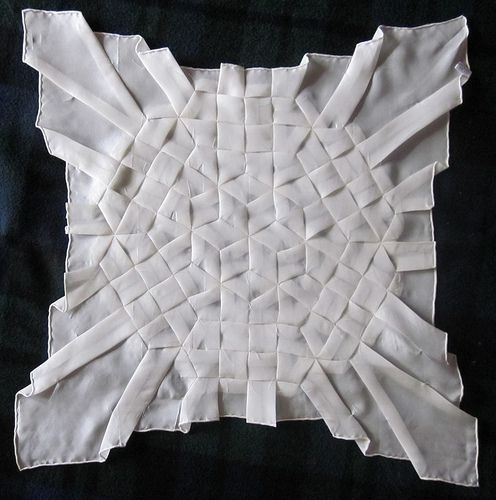
The Dimensional Magic of Sculpted Cloth
Fabric begins as a remarkably modest material: a flat arrangement of threads that folds, drapes, gathers, and responds to the body. With the right combination of pressure, geometry, heat, and restraint, however, that same cloth can become a freestanding architectural surface. A pleated panel can hold a curved edge, a garment can expand and contract like a paper mechanism, and a simple rectangle can acquire the visual authority of sculpture.
This transformation has a rich design lineage. Mariano Fortuny”s Delphos gown introduced delicate, irregular rippling that followed the body with extraordinary fluidity, while Issey Miyake developed permanent pleated forms that treated clothing as a relationship among body, material, and space. Historical context surrounding the Authoritative Source on the Delphos gown shows how Fortuny changed twentieth-century silhouettes and established a precedent for wearable structural art. Hand pleating continues that conversation, making couture principles accessible through paper engineering, careful material testing, and disciplined studio practice.
Haute Couture Lineage and the Mechanics of Form
Fortuny”s Delphos silhouette is often remembered for its narrow, column-like shape and luminous silk, but its real innovation lies in the surface. Extremely fine, undulating pleats gave the fabric stretch, rebound, and a liquid response to movement. Rather than imposing a rigid framework on the wearer, the pleats created a flexible architecture that could contract, elongate, and settle around the body. Reproducing the exact historical process is difficult, yet the underlying principle remains useful: structural strength can come from repeated small movements in the cloth rather than from heavy support materials.
Later pleating practices expanded this principle through experimentation with fiber, machinery, and garment construction. Issey Miyake and textile specialist Makiko Minagawa helped develop a radical inverted manufacturing cycle for PLEATS PLEASE. Instead of pleating broad fabric first and cutting garments from it, the garments were cut and sewn at a larger scale before being passed through the pleating process. Once compressed, the polyester knit formed compact, wearable structures that opened around the body. This method allowed seams, silhouettes, and pleats to function as one integrated system.
For the independent maker, the lesson is not to imitate a famous garment literally, but to understand pleating as a mechanical language. A repeated fold can act as a hinge, spring, rib, or tension line. Origami contributes geometric strategies, kinetic textiles introduce controlled movement, and architectural models demonstrate how flat material can create enclosure and volume.
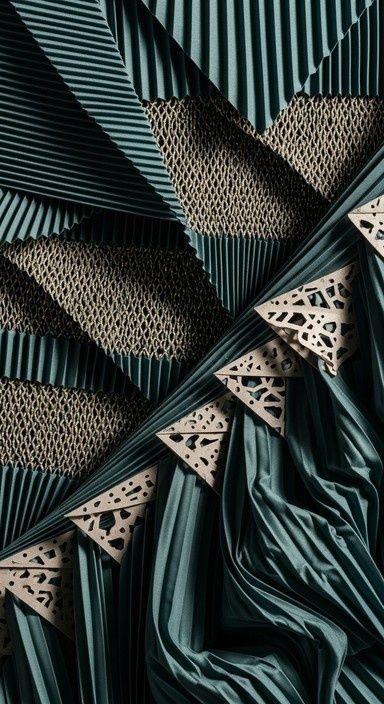
- Repeated narrow pleats create elasticity and surface rhythm.
- Wide accordion folds provide expansion, compression, and bold shadow lines.
- Chevron and diagonal folds redirect tension and encourage curved or spiraling forms.
- Interlocking tessellations distribute stress across a broader textile surface.
Selecting Fibers and Mastering the Grainline
Successful heat pleating begins with fiber awareness. Thermoplastic synthetics such as polyester respond particularly well because heat softens their molecular structure and allows the compressed shape to be fixed as the material cools. Polyester chiffon, lightweight polyester satin, and some warp-knit fabrics can retain crisp folds when the temperature and pressure are controlled. Natural protein fibers such as silk may accept pleats through moisture, pressure, starch, or chemical assistance, but their memory is usually less predictable. Cellulose fibers such as cotton, linen, and rayon often require damp-setting, stitching, resin, or chemical treatment rather than heat alone.
Grain direction affects both appearance and stability. Pleats running parallel to the straight grain usually remain more orderly, while cross-grain arrangements can create different degrees of compression and recovery. The true bias, cut at approximately 45 degrees to the grain, drapes easily but may distort inside a tightly folded mold. Always test a small swatch before committing a full panel, and record the fabric, temperature, time, moisture level, and fold width. Pleating can also cause substantial shrinkage, so prepare more material than the finished dimensions appear to require.
| Studio fabric | Typical behavior | Fold memory | Starting approach |
|---|---|---|---|
| Lightweight polyester chiffon | Fine, flexible, responsive to compression | Strong when fully cooled | Use moderate heat and firm mold pressure |
| Polyester satin | Smooth surface, prone to shine or marking | Strong to moderate | Protect with paper and avoid excessive direct ironing |
| Silk habotai | Soft, fluid, moisture-sensitive | Moderate and variable | Use damp-setting, starch, or resist techniques |
| Cotton lawn | Stable, absorbent, less thermoplastic | Weak under dry heat alone | Combine steam, pressure, starch, or stitching |
| Rayon or viscose | Fluid and absorbent, vulnerable when wet | Variable | Test cautiously with moisture and low pressure |
Designing and Folding Two-Piece Paper Molds
A paper mold is the temporary architecture that teaches fabric how to occupy space. Heavy kraft paper, bristol board, or another firm, heat-tolerant sheet is preferable to thin origami paper. The mold must survive repeated scoring, folding, compression, and exposure to steam or warm air without collapsing. For small samples, a sturdy sheet is sufficient. Larger work benefits from a broad, flexible paper stock that can still fold accurately without cracking.
Begin with a clean geometric plan. Mark the centerline, outer boundaries, and the repeated intervals of the design before scoring. Knife pleats require parallel lines with consistent spacing, while accordion profiles alternate mountain and valley folds. Tessellated patterns may involve triangles, diamonds, chevrons, or offset grids. Keep the first design symmetrical unless asymmetry is intentional, because symmetry makes alignment errors easier to detect.
Prepare two matching halves: one positive mold with raised peaks and one negative mold with corresponding valleys. Score rather than cut the fold lines, using a blunt scoring tool, ballpoint pen without ink, or art-knife spine. Fold every line firmly, then flatten the mold and repeat the process with the second sheet. Add registration marks around the perimeter, along the centerline, and at major pattern intersections. Small notches, drawn arrows, or punched holes can prevent the fabric from shifting during assembly.
- Label mountain and valley folds on the reverse side before shaping the paper.
- Use a ruler and consistent spacing rather than relying on visual estimation.
- Trim fabric slightly smaller than the mold so its edges do not buckle.
- Add alignment marks to both paper halves and transfer matching marks to the textile.
The Studio Steam Setting Process Step by Step
Once the mold and fabric have been tested, condition the textile according to its fiber content. Polyester may be used dry, while silk, cotton, or other natural fibers may respond better to controlled moisture. Press the fabric flat, remove loose threads, and align the intended pleat direction with the grain. Place the textile between the two folded mold halves, matching every registration mark before applying pressure.
- Build the sandwich. Place the fabric between the male and female molds, checking the centerline, edges, and grain. Smooth away wrinkles without stretching the cloth.
- Compress the assembly. Secure the perimeter with clips, clamps, or heat-resistant cotton twill tape. Pressure should be even, but clips must not crush the paper into unwanted marks.
- Apply controlled heat and moisture. Use a steam iron held just above the surface, a suitable steamer, or a carefully monitored oven. Published home methods vary, including approximately 160°C for 25 minutes and approximately 170°C for 20 minutes, while other experiments have used 180°C for 25 minutes. These figures are starting references, not universal instructions.
- Cool before opening. Allow the compressed sandwich to cool completely. Warm polyester can relax or distort when released, undoing the precision established during heating.
- Inspect and cure. Open the mold gradually, support the newly formed textile, and let it rest flat or in its intended sculptural position before further sewing or shaping.
Heat safety is essential. Use ventilation, avoid direct contact between an iron and unknown synthetic fibers, and never leave an oven or steamer unattended. A sacrificial swatch is the most reliable way to identify scorching, melting, discoloration, excessive shine, or insufficient fixation. If the result is soft, increase pressure or adjust the setting time gradually. If the cloth becomes brittle, glossy, or yellowed, reduce the temperature or exposure.
The cooling interval is not a minor finishing detail. It is the point at which the softened fiber structure stabilizes. Releasing the mold too soon can produce rounded, uneven folds, especially at seams and outer edges. Once cool, the textile should be handled gently until its dimensional memory has been evaluated. Only then should it be cut, stitched, dyed, or incorporated into a larger sculpture.
Pushing Geometric Boundaries into Kinetic Textile Art
Linear pleats are an excellent foundation, but they represent only one family of folded structures. Miura-ori patterns use repeated diagonal parallelograms to create surfaces that open and close in coordinated motion. Chevron grids introduce directional energy and can turn a flat rectangle into a curved shell. Organic, shibori-inspired tessellations combine pinching, twisting, binding, and heat-setting to create pods, bubbles, ridges, or thorn-like projections. These methods are especially effective when the goal is a textile surface that feels grown rather than mechanically repeated.
Spatial manipulation also connects fashion design to architectural investigation. A pleated garment can be studied as a responsive enclosure, while a wall panel can be treated as a wearable-scale surface. Fabric remains valuable in this research because it is lightweight, relatively forgiving, and easy to alter. Seams, cuts, stitches, and folds can produce double curvature, visual rhythm, and structural reinforcement without requiring a large industrial setup.
Recent research extends folded textiles into active systems. The study titled Active Fabric Origami Enabled by Digital Embroidery of Magnetic Yarns describes embroidered magnetic yarns that act as remotely controlled hinges. Demonstrated forms include Miura-ori surfaces, Kresling-patterned tubes, blooming structures, and spacer fabrics that switch between standing and collapsed states. The research points toward responsive clothing, soft robotics, thermal-management textiles, and installations that change shape on demand. Hand pleating does not need to reproduce such technology to benefit from its ideas. It can borrow the same principles of hinges, deployment, directional force, and reversible movement.
- Use diagonal folds when a surface must curve rather than simply compress.
- Combine dense and open zones to create controlled expansion.
- Place seams along structural valleys when reinforcement is needed.
- Test movement by hand before adding wire, magnets, stitching, or other actuators.
Bringing Sculptural Dimensions to Your Creative Workspace
Hand pleating becomes repeatable when paper craft, thermal chemistry, and fabric handling are treated as one design system. The paper mold determines the rhythm, the fiber determines how much of that rhythm can be retained, and the heating process fixes the relationship between the two. Precision comes less from expensive equipment than from accurate scoring, consistent pressure, careful alignment, and patient cooling.
Begin with a narrow linear swatch and document every variable. Once the fold memory is reliable, progress to changing pleat widths, diagonal grids, or a small wearable component. Complex garments and sculptural commissions are easier to control when the pattern has already been tested in miniature. Imperfections should be corrected when they compromise structure, but slight differences in handmade folds can also provide tactile character, shadow variation, and evidence of the maker”s hand. The most compelling sculpted textiles balance engineered repetition with the quiet irregularity that makes cloth feel alive.